
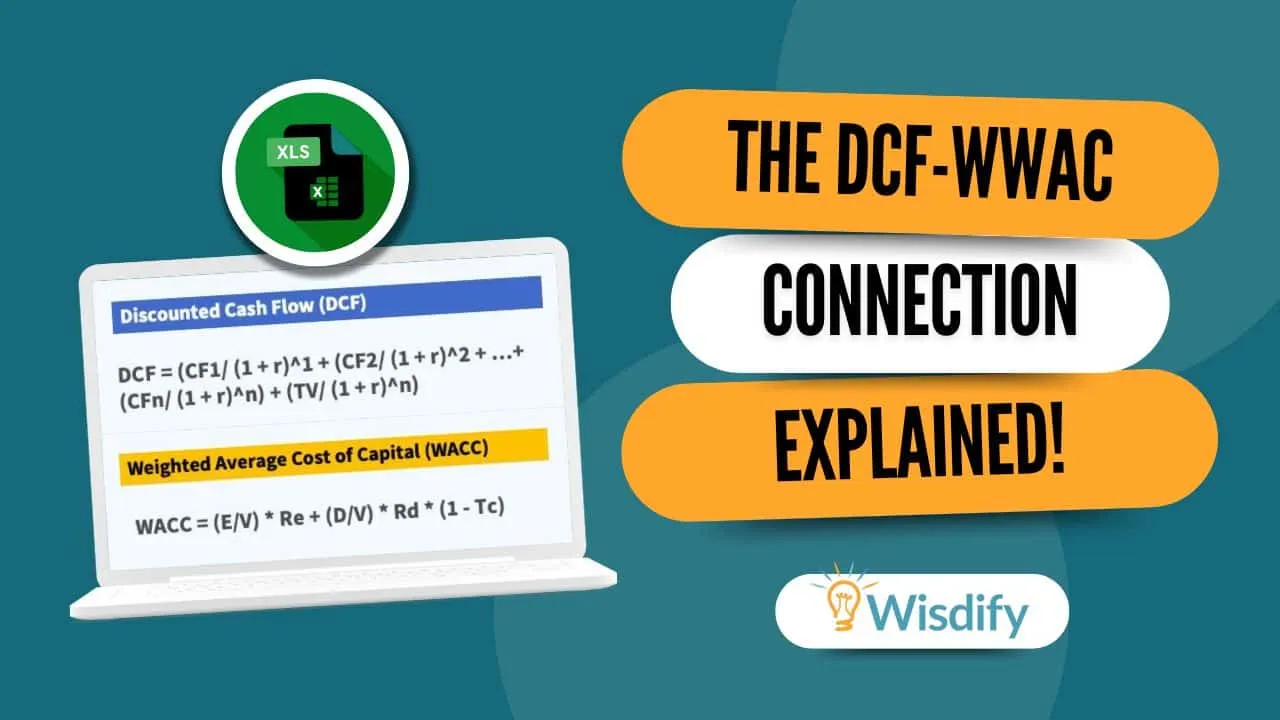
In the world of finance, especially in investment banking, private equity, and corporate finance, understanding how to value a company is crucial. Two fundamental concepts in this valuation process are Discounted Cash Flow (DCF) and Weighted Average Cost of Capital (WACC). These two terms are often used in conjunction, and understanding how they work together can provide a deeper insight into determining a company's intrinsic value.
This post will explore the DCF model and WACC, how each concept functions individually, and how they integrate to guide valuation decisions. Whether you're an aspiring financial analyst or an experienced investor, mastering DCF and WACC will equip you with valuable tools for making informed financial decisions.
For those looking for indepth education I recommend our Valuation & Financial Modeling Course Bundle which is valid for 25.5 NASBA CPE credits.
What Is Discounted Cash Flow (DCF)?
The Discounted Cash Flow (DCF) model is a valuation method used to estimate the value of an investment based on its expected future cash flows. The underlying idea is simple: A company’s value today is the total of its future cash flows, discounted back to the present value using an appropriate rate (WACC, which we’ll cover shortly).
DCF is a widely-used model, particularly for valuing companies, projects, or investment opportunities. It factors in all relevant data to predict future cash flows and determines their value today. The model works well because it allows analysts to account for time, risk, and opportunity cost.
Here’s a basic breakdown of how DCF works:
- Forecasting Future Cash Flows: The first step is estimating a company’s free cash flow (FCF) for future years. This can be done through financial projections based on historical data, market trends, or growth forecasts.
- Discounting Cash Flows: After projecting future cash flows, they need to be discounted to their present value. The further into the future the cash flow is expected to occur, the lower its present value. This is because of the time value of money, which states that a dollar today is worth more than a dollar tomorrow.
- Summing the Cash Flows: Once the cash flows have been discounted, they are summed to determine the present value of all future cash flows. This total is often referred to as the enterprise value (EV) of the company.
- Calculating Terminal Value: The DCF model typically forecasts cash flows for a certain number of years (usually 5 to 10), after which a company is assumed to continue generating cash indefinitely. The terminal value represents the value of all cash flows beyond the projection period and is calculated using either the Gordon Growth Model or an exit multiple.
- Deriving Equity Value: Finally, after the total enterprise value is calculated, net debt is subtracted to arrive at the equity value, which is the value available to shareholders.
What Is Weighted Average Cost of Capital (WACC)?
The Weighted Average Cost of Capital (WACC) is the discount rate used in the DCF model. It represents the average rate of return that investors expect to receive for providing capital to the company. This cost of capital includes both equity (stockholders) and debt (bondholders), weighted based on their proportion in the company’s overall capital structure.
WACC is important because it reflects the risk of the company’s cash flows. A higher WACC means the company’s cash flows are riskier, and a lower WACC implies less risk. The WACC formula is:

Where:
- E = Market value of equity
- D = Market value of debt
- R_e = Cost of equity
- R_d = Cost of debt
- T_c = Corporate tax rate
Components of WACC
- Cost of Equity (Re): This is the return that shareholders require for investing in the company. It is usually calculated using the Capital Asset Pricing Model (CAPM), which factors in the risk-free rate, the equity risk premium, and the company’s beta (a measure of volatility relative to the market).
- Cost of Debt (Rd): The return that lenders require for providing debt capital. This is usually the average interest rate on the company’s debt. Since interest payments on debt are tax-deductible, the cost of debt is adjusted for taxes by multiplying it by (1 – tax rate).
- Debt and Equity Weights: The proportion of debt and equity in the company’s capital structure. The more leveraged a company (higher debt), the greater weight debt will have in the WACC calculation.
How Do DCF and WACC Work Together?
In a DCF valuation, WACC serves as the discount rate used to bring future cash flows back to present value. The relationship between DCF and WACC is critical: WACC reflects the risk of the cash flows, and the DCF model estimates the value based on those cash flows.
Here’s how they work together step-by-step:
- Project Cash Flows Using the DCF Model: Using the DCF method, you forecast future free cash flows for the company, typically for the next 5-10 years. These cash flows represent the money the company is expected to generate and can be used for things like reinvestment, debt repayment, or dividends.
- Apply WACC to Discount Cash Flows: Once the future cash flows are projected, WACC is applied as the discount rate. This reflects the return that both equity and debt holders require given the risk level of the company. For example, a company with volatile cash flows or heavy debt might have a higher WACC, signaling higher risk.
- Sum the Present Values to Get Enterprise Value (EV): After applying WACC to discount each year’s cash flow, sum them together to calculate the enterprise value of the company. This represents the total value of the company’s assets.
- Calculate the Terminal Value: Since companies are expected to generate cash flows indefinitely, the DCF model also includes a terminal value, which accounts for all cash flows beyond the forecast period. This value is also discounted back to present using WACC.
- Determine Equity Value: Finally, subtract the company’s net debt (total debt minus cash) from the enterprise value to get the equity value, which is the value available to shareholders.
The Importance of Choosing the Right WACC
WACC is a critical input in DCF analysis because even small changes in the discount rate can significantly impact the valuation. A higher WACC will result in a lower present value of future cash flows, reducing the overall valuation of the company. Conversely, a lower WACC will inflate the valuation.
It’s crucial to calculate WACC accurately, reflecting the true cost of both equity and debt, and using the appropriate weightings based on the company’s capital structure. Misjudging WACC can lead to either overvaluing or undervaluing a company, which can affect investment decisions.
Sensitivity Analysis: Stress-Testing DCF with WACC
Because WACC is such an important driver in the DCF model, it’s common practice to perform a sensitivity analysis to see how changes in WACC affect the overall valuation. For instance, you might calculate the DCF valuation using different WACC assumptions (e.g., +/- 1% from the baseline). This helps analysts understand how sensitive the valuation is to changes in the cost of capital and can provide insights into the range of possible values.
Conclusion
Understanding how DCF and WACC work together is essential for anyone involved in company valuations, whether you're working in investment banking, private equity, or corporate finance. The DCF model gives a clear picture of the company’s future cash flow potential, while WACC helps quantify the risk associated with these cash flows.
By forecasting cash flows and discounting them using an appropriate WACC, financial analysts can derive the enterprise and equity values of a company. The key takeaway is that while the DCF model estimates future cash flows, WACC ensures that those cash flows are appropriately discounted, given the risk involved in achieving them.
Mastering these two concepts will allow you to make more informed investment and valuation decisions, ensuring that you’re valuing companies accurately and consistently.