
Financial modeling is an integral part of every finance-related job. Finance professionals often utilize the functionality and formulas in Excel to build financial models for their clients. As an entry-level candidate or employee, it is essential that you know how to build financial models in Excel proficiently. Not only will it help you stand out compared to other candidates applying for the same role, but it will also help you once you land your first finance job.
To help you prepare for your first finance role, we'll explain financial modeling and how to use Excel to build these models with real-world examples you can apply to your job.
What is Financial Modeling?
A financial model is a forecast of a company's financial performance presented as a chart, schedule, or table. Analysts commonly build them using a company's historical data in tandem with informed assumptions to project future results.
With financial models, leadership and stakeholders can analyze the data and make decisions about the company's future. Models can show leaders whether acquiring a business is a smart move or whether selling a business unit is necessary. Analysts can extract financial ratios that are useful for budgeting and making financial decisions like taking on debt or increasing investments.
How to Build a Financial Model
The first step in building a financial model is creating a three-statement model, which includes an income statement, balance sheet, and cash flow statement. These three statements are created using the company's historical data and then projected out by about five years to get a better understanding of the company's financial future.
To build a model, you first want to input the company's historical data and create these statements in Excel. For this example, we've input historical data from 2022 and 2023 into our income statement, balance sheet, and cash flow statements below.
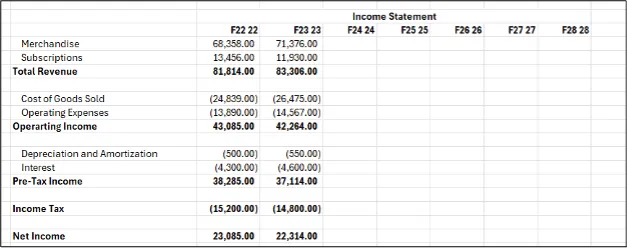
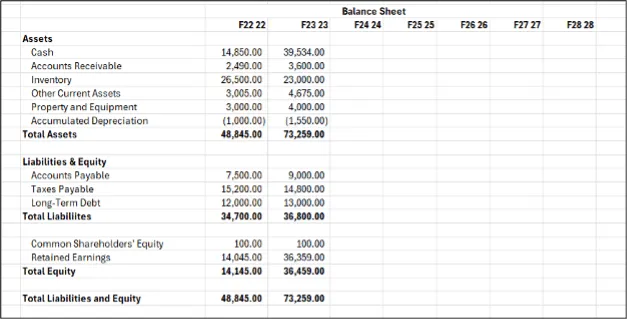
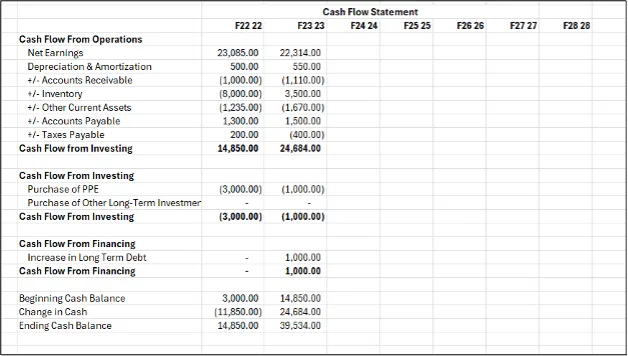
Hint: In addition to basic finance and Excel skills, you also need to have a basic understanding of general accounting principles to know how to build each of these statements. Consider refreshing your knowledge of basic accounting practices before applying for or starting your finance position.
After entering the historical data, the next step is formulating your assumptions to project out each statement. For this example, we will quickly discuss our assumptions for the income statement and then show how we forecast amounts over the next five years.
On a basic level, to formulate assumptions, you'll want to consider factors like historical data, operational strategy, and market conditions. In the illustration below, all our assumptions are highlighted in green.
For this example, we've assumed a 5%-7% growth rate for product growth and a 3%-5% growth rate for subscription growth. Moving down to the assumptions about the cost of goods sold and operating expenses, we used historical data to calculate the percent of revenue compared to each. Then, we used an average for the two historical years to project these amounts out. We did a similar exercise to project the taxes, taking a percentage of the tax compared to net income and then an average for the two years to project the tax rate for the next five years.
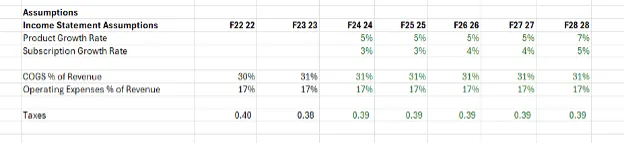
We then applied these assumptions to the historical data in the income statement to forecast this company's income statement over the next five years. Again, all the estimates are highlighted in green.
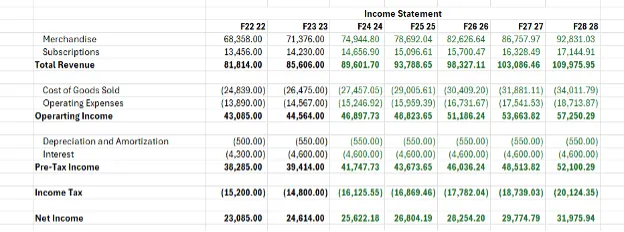
After forecasting the income statement, you can continue to project the balance sheet and cash flow statement.
Advanced Financial Modeling
Once you've mastered the three-statement model, you can build more advanced financial models. These can include the discounted cash flow model and sensitivity analysis. However, advanced models requires a proficiency in modeling and finance, so before attempting these models, you should have a solid foundation of these skills first.
Why Financial Modeling Skills Are Valuable to Employers
Employers in financial services value data modeling skills and are looking for employees who can competently build them. This is particularly applicable to those looking to break into investment banking. Financial modeling is the key to helping companies make strategic decisions, making them valuable to clients. To retain clients and grow, employers want to provide them with clear and well-thought-out projections. Additionally, the ability to create financial models and continue to learn more advanced ones demonstrates to employers your technical and analytical skills as well as your commitment to continued education and growth.
How to Highlight Financial Modeling Skills on your Resume
The skill to build financial models is something that will set you apart from other candidates and is something you want to highlight on your resume. As with any skill you put on your resume, you want to demonstrate how you used the skill to accomplish something. If you can quantify your accomplishments, that is even better.
Also, remember, for entry-level positions, you don't have to limit your resume to what you did in an internship. If you used financial models in one of your courses, include this on your resume, too, so employers know you can have the skill even though you have yet to have the chance to use it in a professional setting. Similar to skills you include from professional experience, you will also want to write a line about how you used or applied financial modeling in your course rather than simply listing it as an Excel skill.
Additionally, be ready to discuss anything you include on your resume in an interview. If you need to improve your skills, consider taking an online course to learn financial modeling.
Conclusion
Financial modeling is a valuable skill, especially for entry-level finance positions. Given how competitive the financial job sector is, being able to competently build financial models can set you apart from the competition.